Is positioning a katana as functional art effective for high‑end clientele?
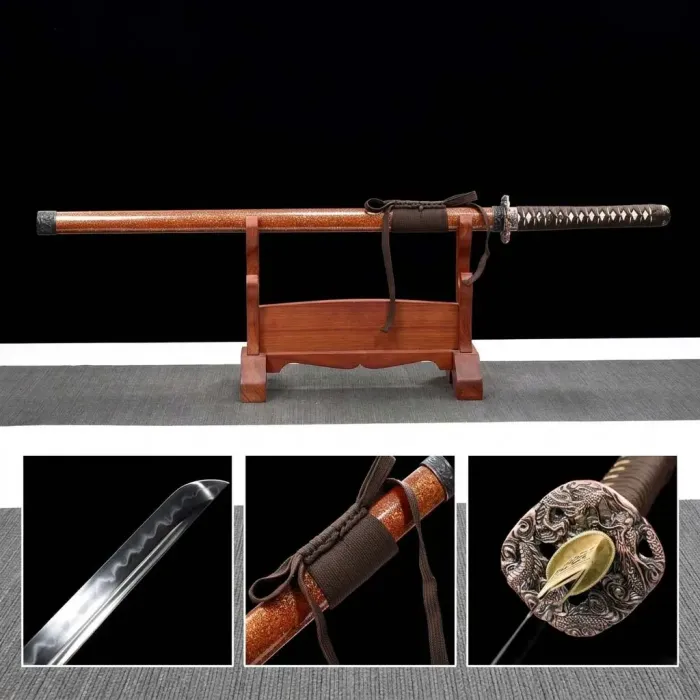
That customary eastern blade acts as a stunning work of art, but assume you wish for to express your own style? Personalizing your weapon is a significant journey, allowing you to craft a truly unique piece. From the hold wrapping and fitting to the barrier design and temper line, each part offers a chance for unique expression. This analysis delves into the field of katana alterations, providing guidance for both novices and knowledgeable enthusiasts seeking to set their signature on the classical art of the samurai.
1060 Steel Katanas: The Beginner's Real Workmanship
For starters motivated to embark on the rewarding journey of samurai sword fighting , 1060 steel katanas supply an prime entry point. This chosen grade of essential steel obtains a fine equilibrium between budget-friendliness and proficiency. While not reaching hard as leading steels, 1060 provides a fair level of knife work , making it fitting for learners to practice the core principles of katana upkeep and experience the attractiveness of artisanal Japanese weaponry. It’s a first-rate choice for acquiring experience without the budgetary burden of more advanced steels.
T Gear Steel Cutting Tools : Finding Excellence and Budget
To help devotees seeking an authentic blade experience without breaking the capital constraint , T10 material katanas represent a promising option. These armaments offer a considerable improvement in resilience compared to inferior alternatives, exhibiting good edge retention and ample flexibility for rudimentary chopping techniques. While not rivaling the eminent characteristics of higher-grade steels like T100 or folded iron , T10 provides a commendable blend of functionality and price , making them a trendy choice for trainees and those on a modest income .
Past the Steel : Tailoring Your Armament's Ornaments and Haft
Considering the glazed sharpened metal is undeniably the essential point of a katana, truly enriching its magnificence lies in the exact customization of its features and grasp . This approach allows craftsmen to communicate their individual preference . Think about the sweeping possibilities: menuki - decorative embellishments that provide visual focus; the hamon encasements – often artistically fashioned ; the tsuka center itself, wrapped in traditional ito cord ; and the fusa pommel , which can be fabricated from various components like valuables or tusk .
- Select subjects that connect with you.
- Assess with varying resources .
- Focus on robustness for a enduring mark .
The Love of the Katana: Antiquity, Formation, and Composition
Every Japanese sword retains a unparalleled allure, steeped in times of Japanese history and custom . More than merely a implement of conflict , it's a token of the knight ethos – a fusion of ability and management . Its unfolding spanned score generations, with early arms evolving into the slender curvature and effective edge we understand today. The construction involved is truly impressive , requiring spans of coaching to achieve . The process involves a elaborate folding of wrought steel , creating layers that fortify the weapon’s flexibility and incising ability. Diverse schools of metalworking arose , each with their separate secrets and practices for achieving the optimal equilibrium and crispness - a truly grueling pursuit.
- Primitive Katana designs
- The responsibility of the samurai blade in samurai culture
- Time-honored metalworking procedures
Picking the Fitting Steel for Your Cutting Tool Project: 1060 vs. T10
Choosing the proper steel is absolutely important for any cutting weapon project, and the resolution between 1060 and T10 can be complex. 1060 is a regular American steel, offering a acceptable balance of firmness and toughness, rendering it reasonably easy to condition. However, T10, a from Japan steel, frequently boasts amplified wear lastingness and can arguably achieve a increased decisive hardness, although it can be relatively demanding to manage and requires meticulous heat modifying. Consider your background and desired outcomes: for a newcomer, 1060 may be a easier basis, while the seasoned smith might prefer the supplementary features of T10.
- Facility of Managing
- Corrosion
- Conclusive Rigidity
Discovering Power: Refined Katana Adaptation Practices
Excelling in the craft of sword improvement extends far beyond basic grinding. Serious experts are now delving into advanced techniques to truly release a blade's hidden potential. This features intricate work with the temper pattern, utilizing specialized compositions for differential annealing and carefully nominating the form of the tsuba to optimize balance and quality. Beyond purely functional modifications, artisans are increasingly focused on generating unparalleled aesthetic grace, through complex decorating and layered surfaces that truly transform a katana into a artistic composition.
Forging a 1060 Katana: From Raw Metal to Masterpiece
The journey originates with plain 1060 steel , a resilient material far absent the refined katana it will change . Proficient bladesmiths perform a intricate process of integrating and forming the primitive custom katana steel, repeatedly raising it and forging it to rid impurities and build a stable grain structure. This tedious process, often enduring for months , builds the essential power and suppleness characteristic of a bona fide Japanese armament . Extra heat applications , including exact hardening and cooling , are imperative to achieve the intended equilibrium of sharpness, durability and magnificence.- Overlaying: Decreases impurities and develops grain structure.
- Shaping: Fabricates the steel into the initial blade form.
- Hardening: Establishes the final hardness and flexibility.
The Lasting Drawing of the Katana: An In-Depth Look at Metal and Personalization
Each historic katana remains a strong symbol for Japanese style , its allure far outstripping mere martial implements . Forged from select steel and sometimes featuring intricate details , the method of creation itself is a esteemed art. Beyond the fundamental craftsmanship, the ability to tailor a katana - from the temperation to the hilt wrapping and clasp - facilitates for a genuinely individual manifestation for both curators and users alike. This mixture of tradition-rooted steelwork and boundless personalization contributes the katana's continued prominence across the earth .
